Walked Out of the Doctor's Office and Already Forgot? Record, Then Ask
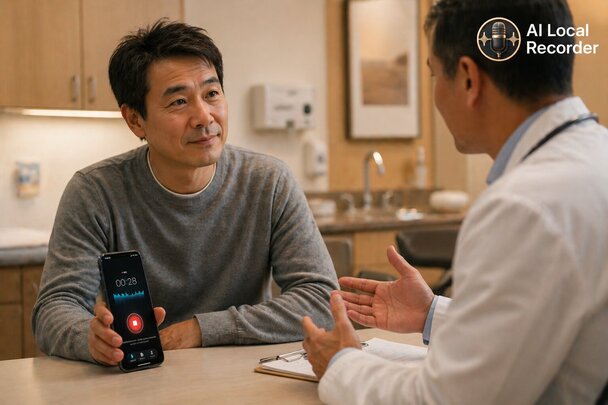
You Just Had a Doctor's Appointment. How Much Do You Remember?
TL;DR: Patients forget 40-80% of what their doctor says, almost immediately. Record the appointment with AI Local Recorder — offline transcription lets you review diagnosis, medication instructions, and follow-up details in searchable text, with zero risk of your medical audio leaving the device.
You walk out of the exam room. The doctor spent 15 minutes explaining your diagnosis, your treatment options, the new medication, how to take it, what to avoid, and when to come back.
By the time you reach the parking lot, the details start to blur.
"Was it one pill with dinner, or two?"
"Did she say I can take ibuprofen, or avoid it?"
"When was that follow-up, exactly?"
This is not your fault. Medical appointments pack a lot of information into a very short time. Studies show that patients forget 40 to 80 percent of what their doctor tells them — almost immediately.
Why Your Memory Isn't the Problem
It is not that you were not paying attention. The structure of a doctor visit works against remembering:
- Short appointment time. The average primary care visit in the U.S. is 15 to 20 minutes.
- Information density. Diagnosis, prognosis, medication names, dosages, timing, dietary restrictions, lifestyle changes, follow-up schedule — all in one conversation.
- Medical terminology. Even when doctors try to speak plainly, terms like "statin," "antihistamine," and "HbA1c" slip in.
- Emotional load. Being told you have a health condition, even a minor one, makes it harder to concentrate on details.
The result: you leave the office with a piece of paper and a fuzzy memory.
What Most People Do (And Why It Falls Short)
- Taking notes during the visit. Try writing down everything your doctor says while you are also trying to listen. Your handwriting will look like a doctor's own prescription pad.
- Using the voice memo app. You can record the conversation, but then you have to replay the entire 15-minute recording to find one detail. Who has time for that?
- Calling the office later. You wait on hold, explain your question to a nurse, and maybe get a callback hours later.
- Googling it. You end up on WebMD at 11 PM, convinced your headache is a brain tumor.
None of these are great options.
A Different Approach: Record It, Then Ask
Instead of trying to remember or scribbling notes, here is a simple workflow:
1. Record the conversation.
Before your appointment starts, tap record on AI Local Recorder. Put your phone in your pocket or on the table. That is it.
The app records in high quality (16kHz) — clear enough to capture both your voice and the doctor's, even in a busy clinic.
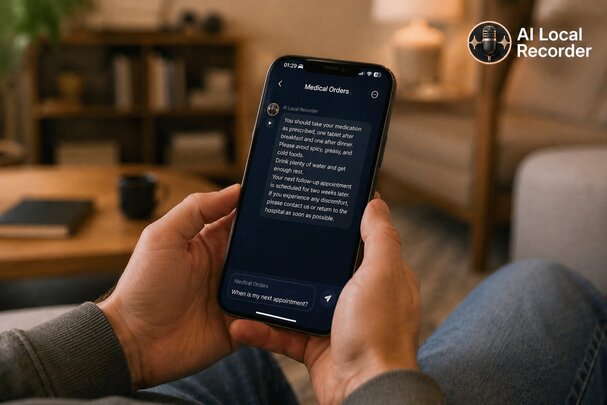
2. Go home. Do not replay the whole recording.
Instead of scrubbing through audio, open the app and type what you need to know:
"What did the doctor say about my new medication?"
"When is my follow-up appointment?"
"What foods should I avoid?"
The AI reads the transcript of your visit and answers in seconds. It is like having a medical scribe in your pocket who remembers everything.
3. Search across visits.
Have multiple appointments? All recordings are searchable by keyword. Need to find what the cardiologist said about your blood pressure back in March? One search, done.
Why Offline Matters Here
Medical information is personal. Really personal.
Many recording apps upload your audio to the cloud for processing. That means your conversation with your doctor — your diagnosis, your medications, your private health details — is sent to someone else's server.
AI Local Recorder processes everything on your iPhone. Recording, transcription, AI answers. Nothing leaves your device.
This matters even more in a medical setting:
- Many clinics and hospitals have spotty cellular reception in exam rooms
- Older patients may not have reliable home internet
- Uploading medical audio feels wrong, even if the privacy policy says it is fine
Who This Helps
- Anyone managing multiple medications. Remembering which pill to take when, with or without food, is genuinely hard.
- Patients with chronic conditions. Regular checkups mean regular instructions. A searchable archive of every visit helps you track changes over time.
- Caring for an aging parent. Accompany them to appointments and record. Later, review with them. Share transcripts with siblings.
- Non-native English speakers. Medical English is hard even for native speakers. Record the visit and go over it later at your own pace.
- Post-surgery patients. Discharge instructions are detailed and easy to forget when you are tired and in pain.
A Note on Asking Your Doctor
Most doctors are fine with you recording the visit if you ask politely. A simple line works:
"Would it be okay if I record this? I want to make sure I remember everything correctly."
If they prefer not to be recorded, you can still take notes or ask for written instructions. But in most cases, doctors appreciate that you are taking your health seriously.
The next time you have a doctor's appointment, try it. One tap to start recording. When you get home just ask.
🎯 Try It Now
AI Local Recorder — Record meetings, lectures, and ideas. AI transcribes offline. Chat with your recordings. Zero uploads, zero subscriptions.
